Decision Making
- Reasons for the growth of decision-making information systems
- People need to analyze large amounts of information
- People must make decisions quickly
- People must apply sophisticated analysis techniques, such as modeling and forecasting, to make good decisions
- People must protect the corporate asset of organizational information
Transaction Processing Systems
- Transaction processing system - the basic business system that serves the operational level (analysts) in an organization
- Online transaction processing (OLTP) - the capturing of transaction and event information using technology to (1) process the information according to defined business rules, (2) store the information, (3) update existing information to reflect the new information
- Online analytical processing (OLAP) - the manipulation of information to create business intelligence in support of strategic decision making
Decision Support Systems
Executive Information Systems
- Executive information system (EIS) - a specialized DSS that supports senior level executives within the organization
- Most EISs offering the following capabilities:
- Consolidation - involves the aggregation of information and features simple roll-ups to complex
groupings of interrelated information
- Drill-down - Enables users to view details, and details of
details, of information.
- Slice-and-dice - The ability to look at information from different perspectives
Artificial Intelligence (A)
- Intelligence system - various commercial applications of artificial intelligence
- Artificial intelligence (A) - stimulates human intelligence such as the ability to reason and learn
- Advantages: can check info on competitor
Four most common categories of AI include:
- Expert system - computerized advisory programs that imitate the reasoning processes of experts in solving difficult problems
- Neural Network - attempts to emulate the way the human brain works
-
Fuzzy logic - a mathematical method of handling imprecise or subjective information
3.
Genetic algorithm - an artificial intelligent system that mimics the evolutionary, survival-of-the-fittest process to generate increasingly better solutions to a problem
4.
Intelligent agent - special-purposed knowledge-based information system that accomplishes specific tasks on behalf of its users
- Multi-agent systems
- Agent-based modeling
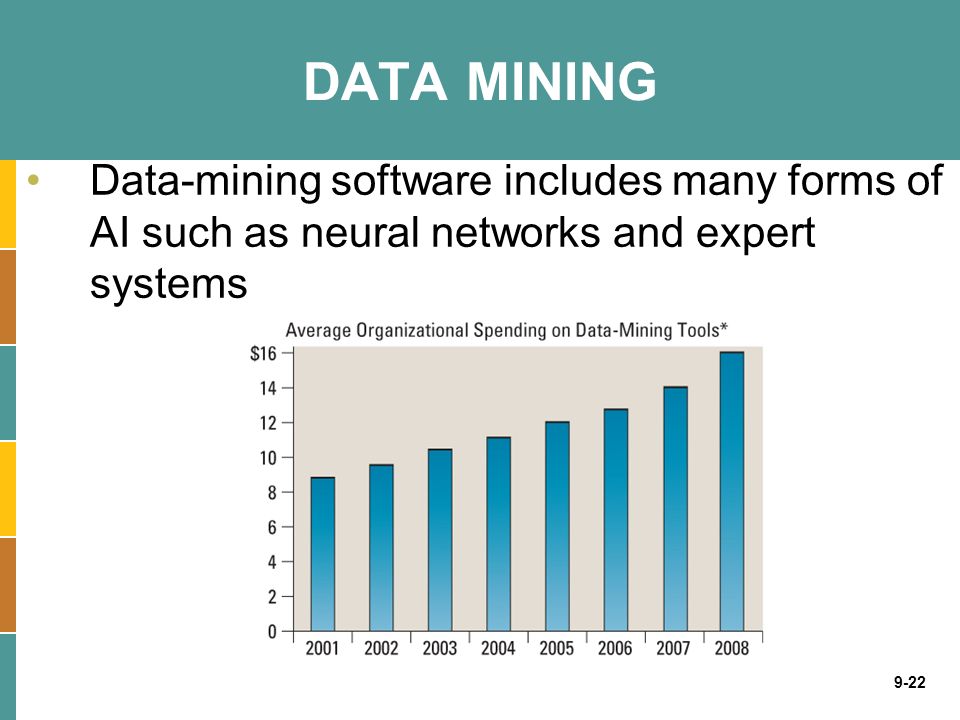
Data Mining
- Common forms of data-mining analysis capabilities include:
- Cluster analysis
- Association detection
- Statistical analysis
CLUSTER
ANALYSIS.
- Cluster
analysis - A technique used to divide an information set into
mutually exclusive groups such that the members of each group are as close
together as possible to one another and the different groups are as far apart
as possible.
- CRM system
depends on cluster analysis to segment customer information
and identify behavioral traits.
- Example:
consumer goods by content, brand loyalty or similarity
ASSOCIATION
DETECTION
- Association
detection – reveals the degree to which variables are related
and the nature and frequency of these relationships in the information.
- Market
basket analysis – Analyzes
such items as Web sites and checkout scanner information to
detect customers’
buying behavior and predict future behavior by identifying affinities among
customers’ choices of products and services
- Example: Maytag uses association detection to ensure that each generation of
appliances is better
than the previous generation.
STATISTICAL
ANALYSIS
- Statistical analysis – performs such functions as information
correlations, distributions, calculations, and variance analysis.
- Forecast – Predictions made on the basis of time-series
information.
- Time series information – time-stamped information collected at a
particular frequency.